Freight Forwarding Market: $560 Billion (2026) to $906.7 Billion (2035) at 5.5% CAGR
NEW YORK, NY, UNITED STATES, September 15, 2026 /EINPresswire.com/ -- The global freight forwarding market is

Press Release Disclaimer: This is a press release distributed through the XPR Media network. It has not been independently verified by our newsroom.
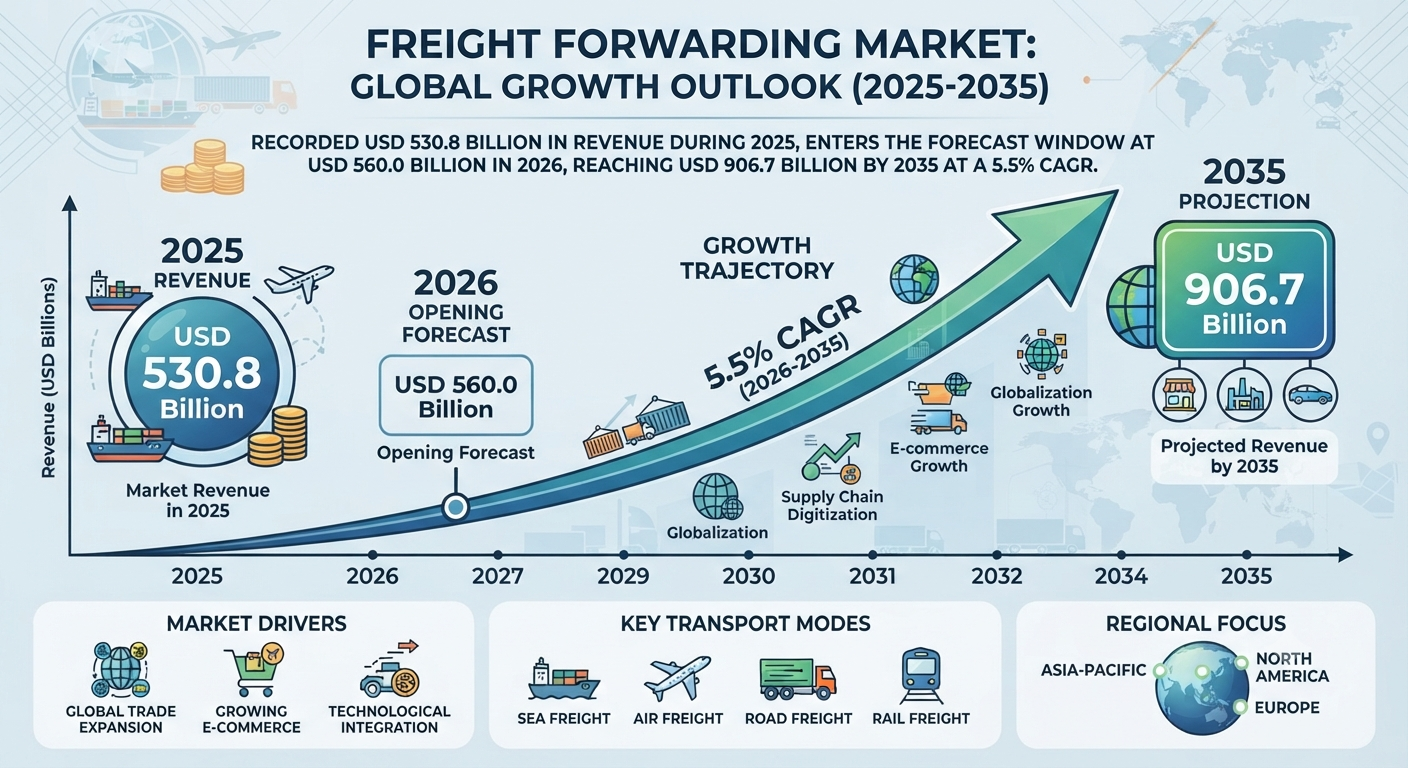

NEW YORK, NY, UNITED STATES, September 15, 2026 /EINPresswire.com/ — The global freight forwarding market is undergoing a major transformation as international trade, cross-border e-commerce, digital logistics, supply-chain restructuring, and sustainability initiatives reshape the movement of goods. Freight forwarders play a critical role in coordinating transportation, customs documentation, warehousing, shipment visibility, and other logistics activities across increasingly complex global supply chains.
According to the latest Market Research Future (MRFR) analysis, the global freight forwarding market generated approximately USD 530.8 billion in revenue in 2025 and is projected to reach USD 906.7 billion by 2035, expanding at a 5.5% CAGR from 2026 to 2035. The market is forecast to reach approximately USD 560.0 billion in 2026.
What Is Freight Forwarding?
Freight forwarding is the coordination and management of shipments between origins and destinations. Freight forwarders generally act as intermediaries between shippers, carriers, customs authorities, warehouses, ports, and other supply-chain participants.
Their services can include:
Transportation management
Customs documentation and clearance
Warehousing
Cargo consolidation
Packaging
Shipment tracking
Insurance coordination
Route planning
Import and export documentation
Multimodal transportation management
As global supply chains become more complicated, businesses increasingly rely on specialized freight forwarding providers to manage international shipments and reduce logistical risks.
Get Sample @ https://www.marketresearchfuture.com/sample_request/11579
Key Factors Driving Market Growth
Expansion of Cross-Border E-Commerce
The rapid growth of e-commerce is one of the most important factors supporting the freight forwarding industry.
Consumers are increasingly purchasing products from international sellers, resulting in larger volumes of cross-border parcels and shipments. At the same time, customers expect faster and more transparent delivery.
This creates demand for freight forwarders capable of coordinating multiple transportation modes, customs procedures, consolidation services, and last-mile connections.
The growth of low-value cross-border shipments is also encouraging the development of less-than-container-load and consolidated freight services.
Increasing International Trade
International trade continues to create demand for transportation and logistics services. Manufacturers frequently source components from multiple countries while selling finished products across several geographic markets.
This creates complex transportation networks involving ocean, air, rail, and road freight.
Freight forwarders help companies coordinate these networks and select appropriate transportation solutions based on cost, delivery time, cargo characteristics, and destination requirements.
Digital Transformation
Technology is becoming a fundamental component of modern freight forwarding.
Digital platforms can allow customers to obtain quotes, make bookings, track shipments, manage documentation, and receive delivery updates through a single interface.
API-based rate integration is also helping freight forwarders connect directly with carriers and provide more current pricing and capacity information.
MRFR highlights digital booking, API rate integration, machine-learning ETA models, and automated customs filing as important developments transforming the industry.
Artificial Intelligence and Automation
Artificial intelligence is moving beyond experimental applications and becoming increasingly relevant to freight forwarding operations.
AI and machine learning can be used for:
Route optimization
ETA prediction
Capacity forecasting
Load matching
Shipment consolidation
Demand forecasting
Document processing
Customs classification
Exception management
The industry is gradually moving from using AI primarily for pricing toward applying it to actual shipment execution.
Predictive systems can identify potential delays and recommend alternative routes before disruptions significantly affect delivery schedules.
Buy Now @ https://www.marketresearchfuture.com/checkout?currency=one_user-USD&report_id=11579
Market Segmentation by Transportation Mode
The freight forwarding market can be divided into ocean, road, air, rail, and multimodal/intermodal forwarding.
Ocean Freight Forwarding
Ocean freight remains the largest mode by revenue because of its cost advantages for large-volume international shipments.
MRFR estimates that ocean freight forwarding accounted for approximately 57.4% of global revenue in 2025. Its position is supported by the scale and efficiency of container shipping across major international trade lanes.
Ocean freight is particularly important for industrial goods, consumer products, machinery, raw materials, and other cargo that does not require extremely rapid delivery.
Road Freight Forwarding
Road transportation provides flexibility and is particularly important for domestic distribution, regional trade, and first- and last-mile connectivity.
The expansion of regional manufacturing networks and nearshoring is increasing the importance of road freight in areas such as North America and Europe.
Air Freight Forwarding
Air freight is preferred for time-sensitive, high-value, lightweight, and temperature-sensitive goods.
Pharmaceuticals, electronics, semiconductors, critical components, and urgent replacement parts are among the products that can benefit from air transportation.
MRFR projects air freight forwarding to expand at approximately 5.9% CAGR through 2035.
Rail Freight Forwarding
Rail offers an attractive option for long-distance inland transportation where cost efficiency and lower emissions are important considerations.
The development of multimodal corridors is creating opportunities for rail to connect ports with inland manufacturing and distribution centers.
Multimodal and Intermodal Forwarding
Multimodal and intermodal transportation is emerging as one of the fastest-growing areas of the freight forwarding industry.
MRFR estimates that this segment will grow at approximately 6.8% CAGR from 2026 to 2035.
Combining ocean, rail, road, and air transportation can provide businesses with greater flexibility when managing cost, delivery times, capacity constraints, and supply-chain disruptions.
Regional Market Outlook
Asia-Pacific represents the largest regional market in the latest MRFR analysis, accounting for approximately 39.8% of 2025 revenue. The region is also projected to record the fastest growth, with a 6.4% CAGR through 2035.
The region benefits from its manufacturing base, extensive export activity, expanding e-commerce sector, and growing investment in transportation infrastructure.
Europe accounted for approximately 24.6% of market revenue in 2025, supported by dense regional trade networks and sophisticated logistics infrastructure.
North America remains an important market and has a particularly high level of digital adoption within freight forwarding.
Emerging markets across South Asia, Africa, and the Middle East are also creating new opportunities as infrastructure investment and international trade corridors expand.
Read More @ https://www.marketresearchfuture.com/reports/freight-forwarding-market-two-11579
Future Opportunities
Several opportunities could shape the next decade of freight forwarding.
SME Self-Service Logistics
Digital platforms can make international freight services accessible to smaller companies that previously lacked the volume or expertise required to negotiate directly with carriers.
Data and Visibility Services
Freight forwarders generate significant amounts of data about transportation routes, rates, capacity, transit times, and delays.
This information can be transformed into subscription-based analytics and supply-chain visibility services.
Cold-Chain Expansion
The growing pharmaceutical and biologics market is creating demand for specialized transportation and temperature-controlled logistics networks.
Emerging Trade Corridors
Investment in infrastructure across South Asia, Africa, and the Middle East is creating new opportunities for freight forwarders willing to develop local networks and specialized services.
Carbon Management
As companies seek more accurate emissions reporting, freight forwarders can develop carbon-accounting tools and lower-emission transportation options as additional revenue streams.
Competitive Landscape
The global freight forwarding market includes major logistics companies such as Kuehne+Nagel, DHL Group, DSV A/S, C.H. Robinson, Expeditors International of Washington, Sinotrans, Nippon Express, UPS, CEVA Logistics, CMA CGM Group, and other regional and international providers.
Competition is increasingly based on network coverage, technology, pricing, customs expertise, shipment visibility, specialized logistics capabilities, and sustainability services.
Large companies are investing in digital platforms while technology-driven freight forwarders are building capabilities in customs, warehousing, and physical logistics.
Browse More Reports:
Composite Slate Roofing Market https://www.marketresearchfuture.com/reports/composite-slate-roofing-market-4506
Converted Flexible Packaging Market https://www.marketresearchfuture.com/reports/converted-flexible-packaging-market-2374
Stick Pouches Packaging Market https://www.marketresearchfuture.com/reports/stick-pouches-packaging-market-2601
Direct Thermal Labels Market https://www.marketresearchfuture.com/reports/direct-thermal-labels-market-4093
Shrink Packaging Market https://www.marketresearchfuture.com/reports/shrink-packaging-market-4264
Glass Container Market https://www.marketresearchfuture.com/reports/glass-container-market-5144
Jerry Cans Market https://www.marketresearchfuture.com/reports/jerry-cans-market-6594
Market Research Future
Market Research Future
+1 855-661-4441
email us here
Legal Disclaimer:
EIN Presswire provides this news content “as is” without warranty of any kind. We do not accept any responsibility or liability
for the accuracy, content, images, videos, licenses, completeness, legality, or reliability of the information contained in this
article. If you have any complaints or copyright issues related to this article, kindly contact the author above.

Media gallery