Healthcare EDI Market to Reach $13.97B by 2035 | Growth Drivers
Healthcare Electronic Data Interchange market projected to hit $13.97B by 2035, driven by regulatory mandates, cloud adoption, and AI. Explore market trends and growth.

Press Release Disclaimer: This is a press release distributed through the XPR Media network. It has not been independently verified by our newsroom.

Healthcare Electronic Data Interchange Market to Surge from USD 5.01 Billion in 2025 to USD 13.97 Billion by 2035-Driven by Regulatory Mandates, Cloud Migration
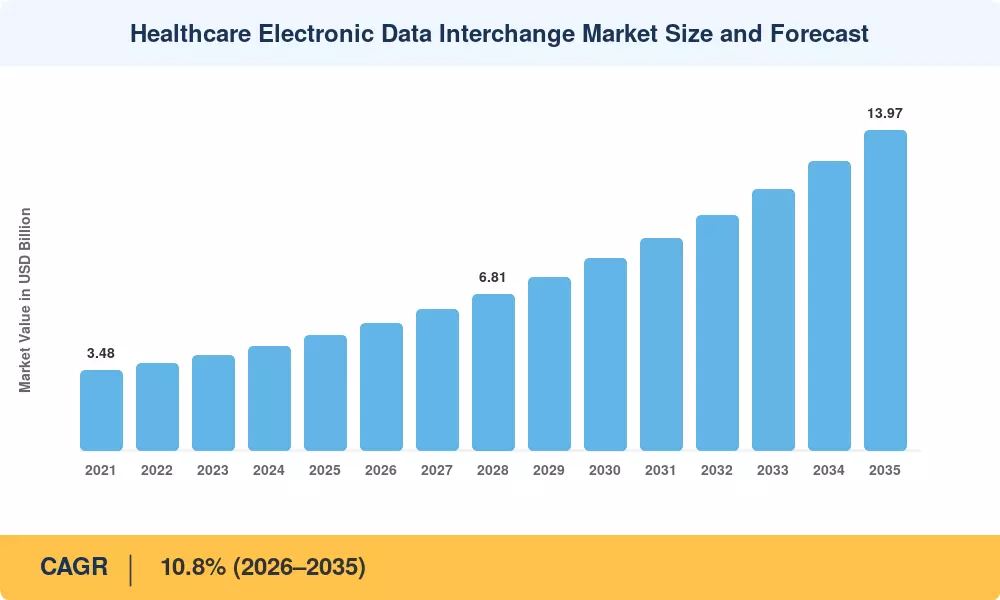
NY, CA, UNITED STATES, September 8, 2026 /EINPresswire.com/ — As per Market Research Future, the global Healthcare Electronic Data Interchange Market size is projected to reach USD 13.97 Billion by 2035 from USD 5.01 Billion in 2025, at a CAGR of 10.8% during the forecast period 2026–2035. The market base was estimated at USD 4.52 Billion in 2024.
The 10.8% CAGR—anchored by structural shifts in healthcare administrative automation—is propelled by three converging forces: the CMS Interoperability and Prior Authorization Final Rule (CMS-0057-F) obliging impacted payers to stand up API-based prior-authorization workflows by January 2027, driving healthcare organizations to modernize electronic transaction infrastructure; advancements in cloud-native clearinghouse platforms and mobile EDI delivery modes, which significantly reduce trading-partner onboarding time and lower total cost of ownership; and the mounting pressure to contain administrative waste, with the CAQH Index pegging unrealized annual savings from fully electronic administrative transactions in U.S. healthcare at roughly USD 20 billion.
Global healthcare IT vendors and regulatory bodies are amplifying this momentum. Optum (including Change Healthcare) maintains an estimated 14–18% share of the global Healthcare Electronic Data Interchange Market, reflecting deep clearinghouse network scale. Waystar completed its Nasdaq listing in June 2024, giving the provider-side segment a public valuation benchmark and fresh acquisition currency. The U.S. federal government committed more than USD 1.6 billion through ONC-successor programs and TEFCA-aligned network build-out between 2021 and 2025, and that spend is now pulling private capital into the market. According to the CAQH Index, only 32% of prior authorizations were completed entirely electronically in 2024, and manual attachment handling costs providers about USD 8.50 per transaction as opposed to USD 1.20 electronically. These forces are creating the regulatory infrastructure and payer-provider demand on which the Healthcare Electronic Data Interchange Market depends.
Request A Free Sample:
https://www.marketresearchfuture.com/sample_request/7338
Key Market Trends & Growth Drivers
Regulatory Mandate Compression
The market is witnessing accelerating demand driven by compliance deadlines. CMS-0057-F, which will go into effect in January 2027, mandates that Medicare Advantage, Medicaid managed care, and federally facilitated exchange plans use Prior Authorization APIs and provide decision metrics. About 200 affected payer organizations must retrofit adjudication engines, and CMS projects ten-year savings of close to USD 15 billion. This trend indicates a shift from voluntary adoption to regulated interoperability, with the Healthcare Electronic Data Interchange Market’s procurement cycles being reshaped by that one rule, pushing the budget forward from 2028 into 2026.
Advancements in Cloud and Mobile Delivery
Innovations in delivery modes are becoming a hallmark of the industry. Cloud-delivered transaction platforms cut typical trading-partner onboarding from twelve weeks to under three, and lower total cost of ownership by 28–35% against on-premises translators. Web- and cloud-based delivery captured approximately 56.8% of the Healthcare Electronic Data Interchange Market in 2025. Mobile EDI is the fastest-scaling delivery mode at an 18.2% CAGR through 2035, driven by home health, behavioural health, and emerging-market deployments where the handset is the only endpoint available.
Integration of AI and Autonomous Claims Processing
The incorporation of artificial intelligence into the industry is gaining traction. Machine-learning models now pre-adjudicate low-complexity claims at accuracy exceeding 95%, compressing turnaround from days to seconds. Vendors embedding inference directly into the transaction path can price on outcomes rather than per-transaction fees, a structural margin shift within the Healthcare Electronic Data Interchange Market. By 2032, autonomous agents will handle eligibility checks, authorization submission, and denial appeals with minimal human touch, with pilot denial-overturn rates near 40% on automated appeals.
Administrative Cost Containment and Security Investment
The rising pressure to reduce administrative waste and strengthen cybersecurity is a primary driver. Manual attachment handling costs providers about USD 8.50 per transaction as opposed to USD 1.20 electronically. February 2024’s clearinghouse compromise disrupted an estimated 94% of U.S. hospitals’ cash flow and triggered USD 6.5 billion in advance payments. Boards responded by funding redundant connectivity, and HHS’s proposed HIPAA Security Rule update—carrying an estimated USD 9 billion first-year industry cost—locks that spending in. The market is projected to expand as healthcare organizations increasingly invest in electronic data interchange to manage administrative efficiency and risk.
Ask for Customization:
https://www.marketresearchfuture.com/ask_for_customize/7338
Market Segment Insights
BY COMPONENT
Software: Largest segment with 52.0% share in 2025, driven by translator and rules-engine licensing that constitute genuine switching costs. Optum continues expanding software capabilities through sustained product innovation.
Services: Fastest-growing segment at a 13.1% CAGR, appealing to organizations facing integration backlogs and managed operations demand that clients cannot staff internally.
Hardware: Positioned as a stable segment catering to on-premises appliance refresh cycles, valued at USD 0.58 Billion in 2025.
BY TRANSACTION TYPE
Claims Management (837/835): Largest segment with 44.7% share in 2025, due to core reimbursement volume and high transaction throughput across payer networks.
Prior Authorization (278): Fastest-growing segment at a 12.4% CAGR, as the CMS API mandate creates the sharpest regulatory pressure and automation remains least mature.
Eligibility & Benefit Verification (270/271): Significant share valued at USD 0.84 Billion in 2025, driven by front-end denial prevention and real-time benefit checks.
Supply Chain Transactions: Emerging segment at an 11.7% CAGR, reflecting DSCSA serialization obligations forcing manufacturers, distributors, and dispensers onto interoperable electronic messaging.
BY MODE OF DELIVERY
Web- and Cloud-Based EDI: Dominant mode with 56.8% share in 2025, offering rapid onboarding, consumption pricing, and 28–35% lower total cost of ownership against on-premises alternatives.
Mobile EDI: Fastest-growing mode at an 18.2% CAGR, positioning itself as an appealing alternative for field-based authorization, home health, and emerging-market deployments.
EDI Value-Added Network: Established segment with 21.4% share, benefiting from entrenched trading-partner communities and legacy connectivity.
BY END USER
Healthcare Providers: Largest segment with USD 2.51 Billion in 2025 spending, driven by denial reduction and cash acceleration imperatives. Waystar continues strengthening provider-facing revenue-cycle automation.
Healthcare Payers: Fastest-growing end user at a 14.2% CAGR, due to API mandates and adjudication automation requirements. Availity continues expanding payer-sponsored network connectivity.
Pharmaceutical & Medical Device Firms: Smaller but significant share at 11.2%, reflecting traceability and rebate processing needs tied to DSCSA compliance.
Read Detailed Insights:
https://www.marketresearchfuture.com/reports/healthcare-electronic-data-interchange-market-7338
Regional Outlook
North America — Market Leader in Transaction Volume
North America leads with 40.0% of global revenue in 2025, generating around USD 2.0 Billion. The region’s growth is driven by HIPAA-mandated transaction sets, CMS API rules, and the highest payer-provider transaction density globally. The United States alone exchanges more than 50 billion administrative transactions annually. The competitive landscape is characterized by continuous innovation and strategic consolidation among leading clearinghouse and health IT vendors.
Europe — Second Largest Market
Europe was valued at USD 1.33 billion in 2025, representing the second-largest regional market. The region benefits from the European Health Data Space regulation adopted in 2025, establishing binding cross-border exchange obligations phased through 2029. Germany’s gematik telematics programme has connected over 150,000 practices, creating the continent’s densest messaging network. Leading countries include Germany, the UK, and France, where major health IT vendors are heavily invested.
Asia-Pacific — Rapidly Growing Market Segment
The Asia-Pacific region accounts for approximately 15% of the global share and grows fastest at a 12.6% CAGR. The growth is driven by India’s Ayushman Bharat Digital Mission, which had registered over 700 million health accounts by 2025 and mandates standardized claims exchange through the National Health Claims Exchange. China’s provincial medical insurance settlement platforms and South Korea’s HIRA real-time claims review are further accelerating adoption. The competitive landscape is evolving with cloud-native entrants winning share without displacing legacy incumbents.
Middle East and Africa — Untapped Potential
The MEA region holds around 5.3% of the global share, valued at USD 0.27 Billion in 2025, driven by national insurance rollouts and hospital digital transformation. Saudi Arabia’s NPHIES platform routes eligibility, pre-authorization, and claims for the entire insured population through a single national exchange. The UAE’s Riayati and Shafafiya claims exchange platforms are leading the way, with Vision 2030 health-sector funding continuing to underwrite expansion.
Competitive Landscape and Recent Developments
The Healthcare Electronic Data Interchange Market is characterized by moderate concentration and rapid technological change, driven by regulatory deadlines and the retirement of legacy infrastructure. The global industry appears moderately fragmented, with an estimated HHI near 900 and the top five participants controlling roughly 43–48% of global revenue.
KEY COMPANIES AND RECENT MILESTONES
Optum (incl. Change Healthcare) (US): Maintains an estimated 14–18% share of the global Healthcare Electronic Data Interchange Market, anchored by clearinghouse network scale, claims processing, and payment integrity services. Rebuilding post-incident trust following the February 2024 ransomware intrusion that disrupted an estimated 94% of U.S. hospitals’ cash flow.
Availity (US) (September 2024): Expanded its attachment and clinical-documentation exchange capability, targeting the least-automated transaction flow in the industry. Holds an estimated 8–11% market share through its multi-payer portal and real-time transaction network.
Waystar (US) (June 2024): Completed its Nasdaq listing, giving the provider-side segment a public valuation benchmark and fresh acquisition currency. Holds an estimated 6–9% share with a revenue-cycle platform and AI-led denial automation narrative.
Cognizant TriZetto (US): Holds an estimated 5–8% share, offering bundled BPO plus platform services including payer core administration and gateway services.
Experian Health (US): Holds an estimated 4–6% share, differentiated by data assets spanning eligibility, claims scrubbing, and identity verification.
Other Key Players: Oracle Health (US), The SSI Group (US), Inovalon (US), McKesson (US), Epic Systems (US), Quadax (US).
Future Outlook: 2026–2035
The Healthcare Electronic Data Interchange Market is projected to reach USD 13.97 billion by 2035, growing at a CAGR of 10.8%, driven by regulatory mandates, cloud migration, and the imperative to reduce administrative waste.
New opportunities lie in:
Expansion into emerging markets with greenfield cloud-native EDI deployments
Development of autonomous claims adjudication and agentic automation to enhance operational efficiency
Investment in data monetization and insight layers, converting transaction exhaust into subscription analytics priced separately from throughput
Convergence of payment integration, embedding virtual card and ACH rails directly into 835 remittance workflows
By 2035, the Healthcare Electronic Data Interchange Market is expected to achieve substantial growth and innovation, with the per-transaction component of vendor revenue falling below 45% as subscriptions, analytics, and embedded finance take over.
More Related Research Insights:
https://www.marketresearchfuture.com/ko/reports/renal-dialysis-market-1409
https://www.marketresearchfuture.com/fr/reports/microbiology-testing-market-697
https://www.marketresearchfuture.com/ja/reports/microbiology-testing-market-697
https://www.marketresearchfuture.com/de/reports/microbiology-testing-market-697
https://www.marketresearchfuture.com/fr/reports/medical-cannabis-market-8368
https://www.marketresearchfuture.com/ja/reports/medical-cannabis-market-8368
https://www.marketresearchfuture.com/de/reports/medical-cannabis-market-8368
https://www.marketresearchfuture.com/es/reports/medical-cannabis-market-8368
https://www.marketresearchfuture.com/zh-cn/reports/medical-cannabis-market-8368
https://www.marketresearchfuture.com/ko/reports/medical-cannabis-market-8368
Market Research Future
Market Research Future
+1 855-661-4441
email us here
Legal Disclaimer:
EIN Presswire provides this news content “as is” without warranty of any kind. We do not accept any responsibility or liability
for the accuracy, content, images, videos, licenses, completeness, legality, or reliability of the information contained in this
article. If you have any complaints or copyright issues related to this article, kindly contact the author above.

Media gallery