
Vadzo Imaging Unveils Armor-830CRS-FPD3: 8MP AR0830 HDR FPD-Link III Camera with Super Low Power, eHDR and LI-HDR for Retail Automation
Built for self-checkout lanes, smart shelves, and multi-store retail deployments that need to run continuously without

Press Release Disclaimer: This is a press release distributed through the XPR Media network. It has not been independently verified by our newsroom.

Built for self-checkout lanes, smart shelves, and multi-store retail deployments that need to run continuously without a matching continuous power bill, this camera pairs the Onsemi HyperLux LP AR0830 sensor with a super-low-power design, eHDR, and LI-HDR processing over FPD-Link III, giving retail technology providers detailed, evenly exposed video across a fleet of stores without the operating cost of a power-hungry camera.
NEW YORK CITY, NY / ACCESS Newswire / August 21, 2026 / Vadzo Imaging, a provider of embedded vision solutions, today unveiled the Armor-830CRS-FPD3, an AR0830 HDR FPD-Link III Camera built around the Onsemi HyperLux AR0830 sensor for self-checkout, smart shelf, and retail loss prevention deployments that need detailed HDR video without the power and operating cost of a continuously demanding camera.
Why Retail Automation Needs an AR0830 HDR FPD-Link III Camera Built for Scale
Retail automation succeeds or fails on a scale that most other camera applications never have to consider. A single self-checkout lane or smart shelf might use one or two camera units, but a national retail chain rolling out that same technology across hundreds or thousands of locations multiplies every camera’s power draw, installation cost, and long-term reliability requirement by the size of the entire rollout. A camera that draws more power than necessary is a minor inefficiency in a single store and a real operating expense line item across an entire chain.
A Super Low Power Camera approaches that problem at the sensor level rather than asking store operations to manage the consequences after installation. Reducing power draw at the source, rather than relying on aggressive duty cycling or reduced resolution to save power, keeps image quality consistent while still meaningfully lowering the electrical and thermal footprint of a large-scale camera deployment.
A second challenge specific to retail environments is lighting variability that a global HDR adjustment alone cannot always resolve. Store lighting, product packaging reflectivity, and window-generated glare near entrances can all vary significantly within the same aisle, which is where eHDR FPD-Link Camera and LI-HDR FPD-Link Camera processing both contribute, each handling dynamic range through a slightly different technical approach to give retail integrators dependable image quality across a full store floor plan.
Power efficiency and dynamic range handling are not separate problems for a retail deployment; they are the same problem viewed from two different angles. A camera that solves lighting variability well but draws excessive power is not actually deployable at the scale a national retail chain requires, and a camera that saves power by cutting corners on image quality does not hold up once store lighting gets difficult. Solving both from the same sensor platform is what makes a camera genuinely suited to retail automation rather than merely adapted to it.
Engineering Explanation: Power Efficiency and Dynamic Range Together
Onsemi designed the HyperLux AR0830 specifically for high-volume deployment scenarios like retail automation, where power efficiency matters as much as image quality. As a HyperLux AR0830 Camera, the sensor delivers 8-megapixel resolution while drawing meaningfully less power than a comparable sensor not built around that specific design goal, which matters directly once a retailer is running that camera continuously across thousands of store locations.
That power efficiency does not come at the expense of dynamic range handling. As an AR0830 Low Power Sensor, the camera combines eHDR, which merges multiple exposures on-chip before the frame leaves the sensor, with LI-HDR processing that extends dynamic range from a single linear exposure. Together, these give a 4K Low Power HDR Camera genuine flexibility in how it resolves a scene’s dynamic range depending on whether the moment calls for combining exposures or preserving a single clean linear capture, rather than relying on one fixed HDR technique for every lighting condition a store presents.
Connectivity is the third piece of the retail automation puzzle. As an AR0830 Coax Camera, the Armor-830CRS-FPD3 uses FPD-Link III to carry video, control signals, and power over a single coaxial cable, which simplifies installation across a retail floor plan where running separate power and data cables to every shelf camera or checkout lane camera position would add real labor cost to a large rollout. A Low Power Coax Camera configuration like this one also reduces the electrical infrastructure a store needs to support a full camera deployment, since lower per-unit power draw compounds meaningfully across dozens of camera units in the same building.
For retail technology providers standardizing on a single camera platform, an 8MP LI-HDR Camera configuration and an 8MP HDR FPD-Link III Camera configuration both draw from the same underlying hardware, meaning a provider can select the processing approach that fits a specific fixture or lane without qualifying an entirely different camera module for each use case.
Product Overview
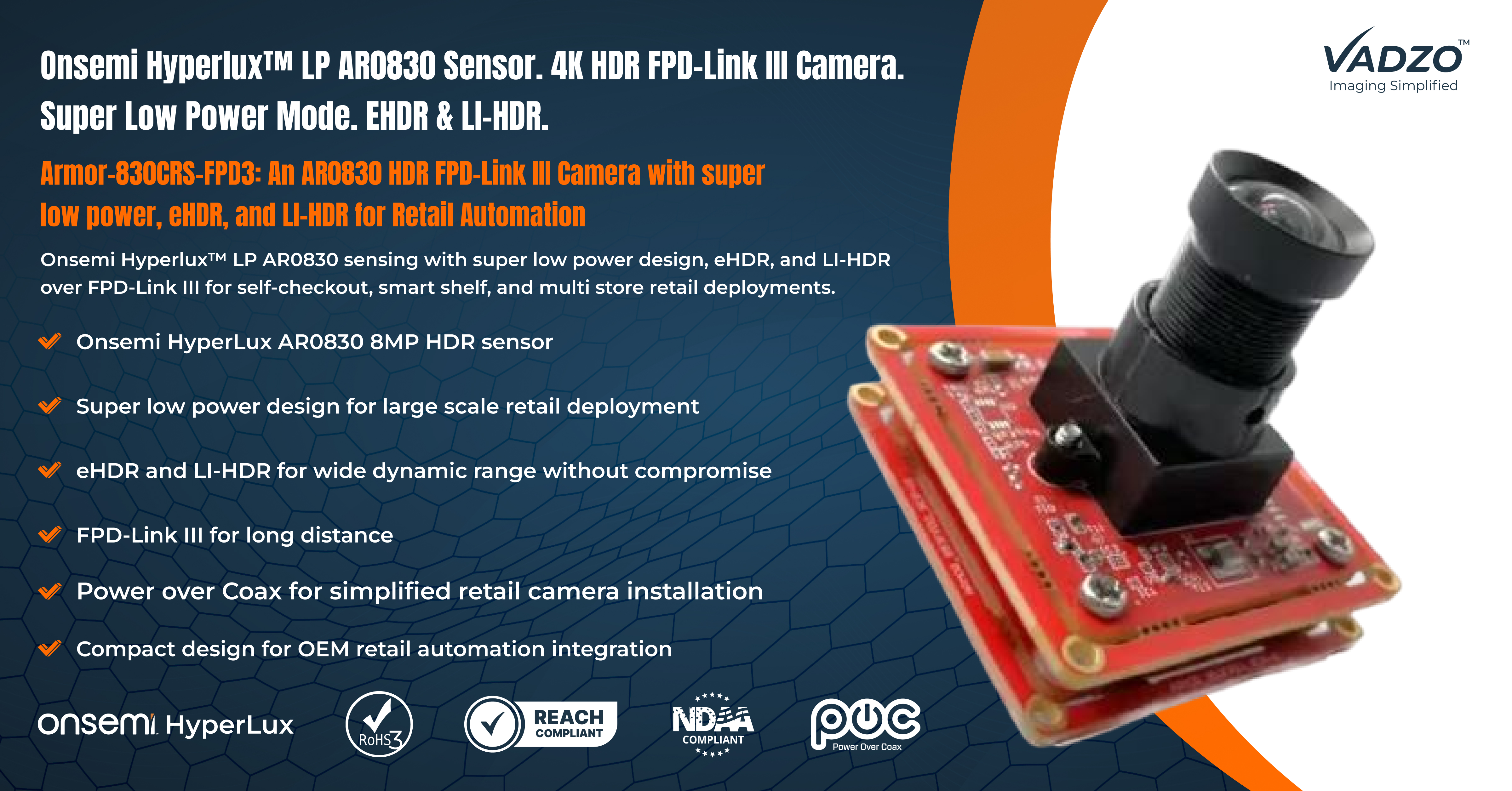
The Armor-830CRS-FPD3 pairs the AR0830 FPD-Link III Camera sensor with a super low power design, eHDR and LI-HDR processing, and FPD-Link III connectivity in a compact design suited to self-checkout, smart shelf, and retail kiosk integration. As an AR0830 HDR FPD-Link III Camera, it outputs full 8-megapixel resolution with HDR processing active by default, giving retail technology providers a single camera platform that covers checkout monitoring, shelf analytics, and general-purpose retail vision from one module.
At the core of the module sits the Onsemi AR0830 HDR Camera sensor, chosen specifically for the combination of low-power operation and dynamic range flexibility that large-scale retail deployment requires. Because the camera pairs 4K eHDR Coax Camera processing with a 4K FPD-Link Camera Module design, the Armor-830CRS-FPD3 reaches usable image quality across a full store’s varied lighting while drawing meaningfully less average power than a comparable camera not built around that specific efficiency goal.
Product Specifications
Key specs: 8MP (3840 × 2160) | Onsemi AR0830 HyperLux LP | 1/2.9 inch | 1.4 µm pixel | eHDR and LI-HDR | Rolling Shutter | FPD-Link III | Power over Coax | Super Low Power Design
Key Capabilities
Onsemi HyperLux AR0830 Sensor for Detailed 8MP HDR Capture: The Armor-830CRS-FPD3 is built around the Onsemi HyperLux AR0830 sensor, a device engineered specifically for high-volume, power-conscious deployment scenarios like retail automation. This gives the module genuine 8MP low-power camera performance suited to the scale a national or multi-store retail rollout actually demands, rather than a sensor adapted from a lower-volume application.
Super Low Power Design for Efficient Retail Deployment: Reducing power draw at the sensor level, rather than through aggressive duty cycling that could compromise responsiveness, keeps the Armor-830CRS-FPD3 ready for continuous retail floor monitoring while still meaningfully lowering the electrical footprint of a large-scale deployment. As an OEM Low Power Camera Module, it gives OEM customers a foundation to standardize on across every camera position in a store without a corresponding jump in electrical infrastructure requirements.
eHDR and LI-HDR for Wide Dynamic Range Without Compromise: Retail environments combine product packaging reflectivity, variable store lighting, and window-generated glare in ways that a single fixed HDR technique cannot always resolve equally well. By combining eHDR’s multi-exposure on-chip combination with LI-HDR’s single-exposure linear extension, the Armor-830CRS-FPD3 gives integrators two complementary approaches to dynamic range, selectable based on which technique better fits a specific fixture or lighting scenario within a store. As an HDR FPD-Link III Camera, it also fits directly into Vadzo Imaging’s broader high dynamic range camera portfolio, giving integrators a consistent point of comparison against other coax-connected HDR modules. Selecting between eHDR and LI-HDR on a fixture-by-fixture basis, rather than committing an entire store to a single technique, lets a retail technology provider tune each camera position to the lighting conditions that position actually experiences rather than accepting a one-size-fits-all compromise.
FPD-Link III for Long Distance, EMI Resistant Video Transmission: Retail fixtures, shelf edges, and checkout lanes often place a camera some distance from the nearest recording or networking equipment, in an environment with electrical noise from point of sale hardware, lighting ballasts, and other store equipment. As a FPD-Link Retail Camera Kit, the Armor-830CRS-FPD3 carries video reliably over a single coaxial cable engineered for exactly that kind of commercial electrical environment.
Coax Connectivity for Simplified Retail Camera Installation: Running separate power and data cables to every shelf camera or checkout lane position across a large store adds real labor cost to a retail automation rollout. Coaxial connectivity consolidates both onto a single cable, which matters directly when a retail technology provider is installing dozens of camera units per store across a chain-wide deployment. That reduction in cabling also shortens installation time per store, which becomes a meaningful scheduling advantage when a rollout needs to move through a large number of locations without disrupting normal store operations for an extended period at any single site.
Compact OEM Ready Design for Retail Automation Integration: The module’s compact footprint gives OEM customers flexibility to integrate the Armor-830CRS-FPD3 into a self-checkout kiosk, a shelf edge fixture, or a ceiling-mounted enclosure without a major mechanical redesign. Vadzo Imaging supports full customization on this platform as a Low Power Camera Manufacturer, including connector changes, housing design, and firmware adjustments for retail technology providers headed into volume production.
“Retail technology providers do not evaluate a camera on image quality alone; they evaluate it on what happens when that camera is multiplied across thousands of store locations. The AR0830’s super low power design combined with eHDR and LI-HDR gives the Armor-830CRS-FPD3 real image quality and genuine operating efficiency in the same module, without asking a retailer to accept a compromise on either one. Every specification we chose for this platform was weighed against what happens at store number one thousand, not just store number one. We built this camera for rollouts measured in thousands of units, not single store pilots.” – Alwin Vincent, Product Manager at Vadzo Imaging.
Application-Specific Sections
Self-Checkout and Automated Checkout Systems: Self-checkout lanes need vision that reliably identifies items and confirms scans without a camera that adds noticeable cost when multiplied across every lane in every store. As a Self-Checkout Camera Module, the Armor-830CRS-FPD3’s low-power design keeps that per-lane cost manageable at scale, and functioning as an Automated Checkout Vision Camera, it delivers the HDR image quality needed to read items reliably under typical checkout lighting.
Smart Shelf and Inventory Monitoring: Shelf monitoring systems tracking stock levels and product placement need camera coverage positioned throughout a store, often in large numbers relative to a checkout deployment. As a Retail Shelf Monitoring Camera, the Armor-830CRS-FPD3 supports that scale, and an Inventory Tracking Camera Module configuration of the same module extends that capability to stock level and planogram compliance monitoring across an aisle.
Retail Loss Prevention: Loss prevention teams need camera coverage across entrances, high-value aisles, and checkout areas that holds up under scrutiny without the operating cost of continuous full-power streaming across every position. A Retail Loss Prevention Camera built on this platform delivers that coverage, and functioning as a Smart Shelf Vision Camera, it extends the same capability to shelf-level shrink monitoring. Because the same camera platform covers both entrance-level and shelf-level coverage, a loss prevention team can standardize on one set of camera specifications across an entire store layout rather than qualifying separate hardware for each type of coverage.
Retail Analytics and Customer Insights: Customer traffic patterns, dwell time, and engagement analytics all depend on consistent video quality across a store’s varied lighting conditions and camera positions. As a Retail Analytics Camera, the Armor-830CRS-FPD3 supplies that consistency, and deployed as a Retail Kiosk Camera Module, it extends the same image quality to interactive kiosk and digital signage applications throughout a store.
OEM Integration for Retail Technology Providers: Retail technology providers building their own checkout, shelf monitoring, or kiosk hardware need a camera vendor who understands the scale and power efficiency requirements a multi-store rollout demands. The Armor-830CRS-FPD3 ships from a Coax Retail Camera Supplier with those requirements built in, and Vadzo Imaging supports OEM customization for cable length, connector type, and firmware for providers standardizing on one camera across multiple retail hardware lines. As a Smart Retail Camera Module, it fits directly into a provider’s existing product architecture without requiring a redesign around a new camera’s specific requirements.
Frequently Asked Questions
Q: Why does power consumption matter for a retail camera deployment in the same way it matters for a battery-powered device?
A: A single camera’s power draw is a minor line item in one store, but a retail chain rolling out that same camera across hundreds or thousands of locations multiplies that draw by the size of the entire deployment, turning a small per-unit inefficiency into a real recurring operating expense. Retail deployments also often add camera units incrementally over time, at checkout lanes, shelf edges, and entrances, which means the total camera count in a single store can grow well beyond an initial installation plan. Vadzo Imaging designs its retail camera products around genuine low-power operation at the sensor level specifically because that scale effect is predictable and significant, not a marginal concern that only matters for a battery-powered or off-grid device. A retailer planning a rollout can reasonably estimate that recurring cost in advance, which makes a camera’s per-unit power draw a genuine line item in a deployment budget rather than an afterthought discovered only after installation.
Q: What is the difference between eHDR and LI-HDR, and why would a camera use both?
A: eHDR combines multiple exposures on the sensor itself before the frame leaves the camera, which extends dynamic range effectively but works best when a scene is relatively still, while LI-HDR extends dynamic range from a single linear exposure, which holds up better under motion since there is no second exposure to combine or misalign. Rather than committing to one approach for every scenario, a camera that supports both can apply whichever technique better fits a specific fixture, lighting condition, or amount of motion in the scene. Vadzo Imaging includes both processing approaches on its retail camera products so integrators are not locked into a single HDR strategy across every camera position in a store.
Q: Why would a retail chain use a coax-connected camera instead of a standard IP camera for self-checkout or shelf monitoring?
A: A standard IP camera depends on network infrastructure and often a separate power run to every camera position, which adds real installation labor when a store is deploying camera units at dozens of checkout lanes and shelf positions at once. A coax-connected camera using a link like FPD-Link III carries video, control signals, and power over a single cable, simplifying that installation and reducing the electrical infrastructure a store needs to support a full camera rollout. Vadzo Imaging designs its retail camera products around this connectivity so technology providers can deploy at scale without multiplying installation cost and complexity across every additional camera position.
Q: Can Vadzo Imaging customize a retail camera module for a specific self-checkout or shelf monitoring platform?
A: Yes. Vadzo Imaging supports full OEM customization across its retail camera portfolio, including housing design suited to a specific kiosk, shelf fixture, or ceiling mount, connector and cable length configuration, and firmware adjustments tuned for a particular HDR or power profile. Evaluation units ship with no minimum order requirement, and the same engineering team that built the standard product works directly with retail technology providers to adapt the module for a specific checkout, shelf monitoring, or kiosk platform headed into volume production. That direct engineering relationship matters most during the transition from a pilot deployment to a full rollout, when small design details that worked fine in a handful of stores need to hold up consistently across hundreds of locations.
Q: What should retail technology providers look for when choosing a camera supplier for a large multi-store rollout?
A: A camera that performs well in a single pilot store does not automatically perform well once multiplied across hundreds or thousands of locations, since small per-unit differences in power draw, installation complexity, and reliability all compound at that scale. Providers should look for genuine low-power design rather than power management that only shows up in a spec sheet footnote, a connectivity approach that reduces rather than adds installation labor, and a supplier able to support consistent hardware and firmware across a long, multi-year rollout. Vadzo Imaging builds its retail camera products around exactly these priorities, since a supplier who only optimizes a single store pilot is not necessarily prepared to support a true chain-wide deployment.
Availability
The Armor-830CRS-FPD3 AR0830 HDR FPD-Link III Camera is available now for evaluation and OEM integration. Evaluation kits include the camera module, an FPD-Link III deserializer reference board, mounting hardware suited to common retail fixtures, and integration documentation covering eHDR and LI-HDR configuration, power profile tuning, and installation guidance, with no minimum order requirement. Contact Vadzo Imaging at support@vadzoimaging.com to request an evaluation unit or discuss volume production and OEM customization. Evaluation feedback is also welcome directly through the same contact channel, since real deployment conditions across a pilot store often surface details a bench test alone would not reveal, and that feedback loop helps refine the configuration before a provider commits to a full chain-wide order.
About Vadzo Imaging
Vadzo Imaging develops embedded and machine vision camera products for OEMs, system integrators, and retail technology providers building production-ready vision systems across retail automation, security, robotics, and edge AI. The company’s portfolio spans MIPI CSI-2, USB, GigE, Wi-Fi, FPD-Link III, and SerDes interface camera products, supporting deployment architectures from compact onboard modules to distributed networked and coax-connected installations. Vadzo provides end-to-end imaging support including sensor integration, ISP tuning, firmware development, and SDK frameworks to accelerate system deployment, and the company’s engineering team works directly with customers throughout evaluation, pilot deployment, and volume production rather than handing off support after the initial sale. Visit Vadzo Imaging to explore the full embedded vision camera portfolio.
Media Contact
Alwin Vincent
Vadzo Imaging
Email: alwin@vadzoimaging.com
LinkedIn: Vadzo Imaging
YouTube: Vadzo Imaging
X: Vadzo Imaging
SOURCE: Vadzo Imaging
View the original press release on ACCESS Newswire
Media gallery



