
The Market for Chronic Obstructive Pulmonary Disease (COPD) and Asthma Devices Is Growing, Projected to Hit $94.72
The Business Research Company’s Chronic Obstructive Pulmonary Disease Global Market Report 2026 – Market Size, Trends,

Press Release Disclaimer: This is a press release distributed through the XPR Media network. It has not been independently verified by our newsroom.
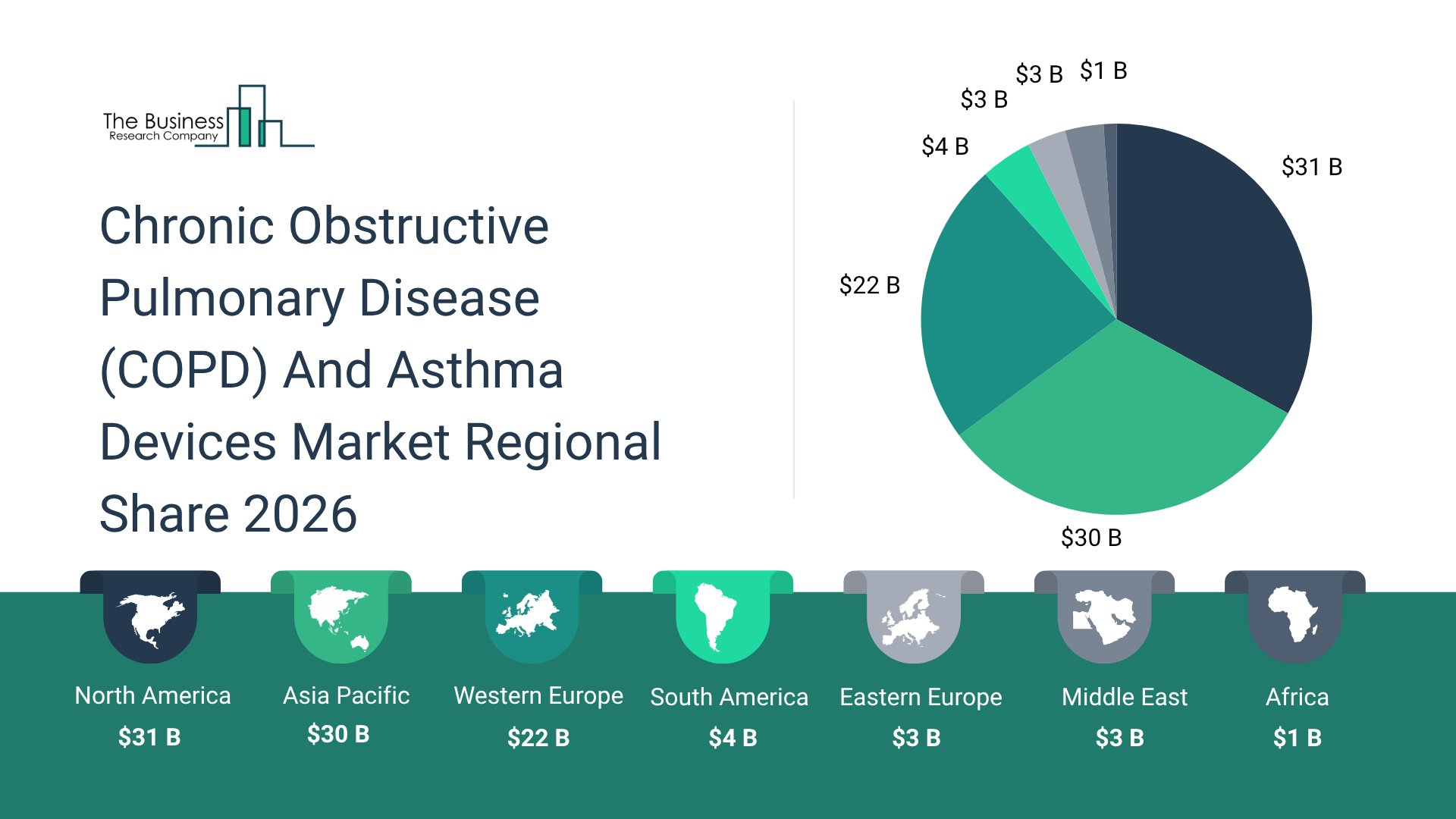

The Business Research Company’s Chronic Obstructive Pulmonary Disease Global Market Report 2026 – Market Size, Trends, And Forecast 2026-2035
LONDON, GREATER LONDON, UNITED KINGDOM, October 26, 2026 /EINPresswire.com/ — The market for Chronic Obstructive Pulmonary Disease (COPD) and asthma devices is on track for substantial growth, reflecting the increasing global focus on respiratory health. As medical technology advances and patient needs evolve, this sector is expected to play a vital role within the broader medical equipment industry. Here’s an in-depth look at the market’s size, regional dominance, key drivers, and leading companies shaping the future of respiratory care devices.
Market Size and Projected Growth of the COPD and Asthma Devices Market
The Chronic Obstructive Pulmonary Disease (COPD) and asthma devices market is anticipated to exceed $95 billion by 2030. This segment represents nearly 8% of the wider Medical Equipment industry, which itself is forecasted to reach a total valuation of $1,176 billion by that year. Such figures highlight the significant role respiratory devices will continue to play in healthcare.
Request A Free Sample Of The Chronic Obstructive Pulmonary Disease (COPD) And Asthma Devices Market Report
https://thebusinessresearchcompany.com/sample_request?id=26415768&type=smp&name=Chronic%20Obstructive%20Pulmonary%20Disease%20%28COPD%29%20And%20Asthma%20Devices%20Market%20Report%202026&utm_source=EINPresswire&utm_medium=Paid&utm_campaign=OctPR
North America as the Leading Region for COPD and Asthma Devices in 2030
By 2030, North America is expected to dominate the COPD and asthma devices market, holding a value of $31 billion. The market is projected to grow from $23 billion in 2025, registering a compound annual growth rate (CAGR) of 6%. This robust expansion is driven by factors such as a high prevalence of chronic respiratory illnesses, widespread adoption of advanced inhalation treatments, increasing investments in respiratory healthcare, supportive reimbursement policies, heightened awareness about early diagnosis and management, as well as ongoing innovations in inhaler technology that enhance patient experience and connectivity.
The United States as the Top Country in the COPD and Asthma Devices Market
The U.S. will be the leading country within this market by 2030, with a forecasted valuation of $27 billion. Growth is expected at a CAGR of 6%, rising from $21 billion in 2025. Key contributors include the aging population increasingly vulnerable to respiratory diseases, higher prescription volumes for both maintenance and rescue inhalers, strong uptake of home-based respiratory care solutions, the growing use of digital inhalers equipped with adherence tracking, and continual clinical advances aimed at optimizing treatment results and improving patients’ quality of life.
Access The Detailed Chronic Obstructive Pulmonary Disease (COPD) And Asthma Devices Market Report Here
https://thebusinessresearchcompany.com/report/chronic-obstructive-pulmonary-disease-copd-and-asthma-devices-global-market-report?utm_source=EINPresswire&utm_medium=Paid&utm_campaign=Oct_PR
Dominant Product Segment in the COPD and Asthma Devices Market by 2030
Among various device types—metered dose inhalers, dry powder inhalers, soft mist inhalers, jet nebulizers, ultrasonic nebulizers, and others—the metered dose inhalers segment is projected to be the largest, accounting for 34% or $32 billion of the market in 2030. Their widespread clinical acceptance in managing asthma and COPD, efficient and rapid drug delivery with precise dosing, increased availability of combination medications, preference for portable devices, and ongoing design improvements that boost medication adherence and ease of use underpin this segment’s strong position.
Segmentation Overview of the COPD and Asthma Devices Market
The market is classified by several dimensions including device type (such as inhalers and nebulizers), medical indication (asthma or COPD), application setting (hospitals, clinics, home care, research institutions, among others), and end users, which include pediatric, adult, and geriatric populations. This segmentation helps cater to diverse patient needs and healthcare environments worldwide.
Expected Compound Annual Growth Rate Leading to 2030
Overall, the COPD and asthma devices market is projected to grow at a CAGR of 7% through 2030, reflecting sustained demand driven by demographic shifts and technological innovation.
Factors Propelling Growth in the Global COPD and Asthma Devices Market
Rising Incidence of Chronic Respiratory Diseases
One of the primary factors fueling market growth is the increasing prevalence of chronic respiratory conditions, including asthma and COPD. Factors such as pollution, smoking, occupational hazards, and unhealthy lifestyles contribute to this rising disease burden. Healthcare providers are thus expanding the use of inhalation therapies, nebulizers, and monitoring devices to improve patient outcomes and long-term disease management, contributing roughly 2.9% annual market growth.
Aging Population’s Impact on Market Expansion
The growing elderly population also significantly influences market growth. As respiratory impairments become more common in older adults, demand increases for ongoing respiratory therapies and personalized care. This demographic often requires extensive monitoring and long-term treatment, prompting healthcare systems to scale chronic disease management programs. The aging population is expected to add around 2.8% annual growth to the market.
Expanding Preference for Home-Based Respiratory Care
There is a notable shift towards home-based respiratory care, which supports the market’s expansion. Patients increasingly favor managing their conditions outside traditional healthcare facilities, leading to higher adoption of portable respiratory devices. Technological advancements and remote monitoring solutions improve treatment adherence and accessibility, contributing an estimated 2.5% to annual growth.
Key Market Opportunities Across Device Types
Significant growth prospects lie within segments such as metered dose inhalers, dry powder inhalers, soft mist inhalers, jet nebulizers, ultrasonic nebulizers, and other device categories. Together, these segments are forecasted to generate more than $27 billion by 2030. The market momentum is driven by the rising use of advanced inhalation therapies, preference for convenient and portable devices, expanded access in developing healthcare markets, continuous innovation in drug delivery, and a growing focus on personalized respiratory disease management.
Projected growth from 2025 to 2030 includes an increase of $9 billion for metered dose inhalers, $8 billion for dry powder inhalers, $4 billion for jet nebulizers, and $2 billion each for soft mist inhalers, ultrasonic nebulizers, and other types. This dynamic market features a balance of global pharmaceutical companies and respiratory device manufacturers who focus heavily on innovation, digital health integration, and patient-centric designs to optimize therapy outcomes.
Leading Company in the COPD and Asthma Devices Market
In 2025, AstraZeneca Plc led the global market with a 10% share. Their comprehensive respiratory and immunology portfolio features a wide range of inhaled maintenance therapies and combined drug-device products that help control symptoms, reduce exacerbations, and improve lung function for COPD and asthma patients.
Major Competitors Shaping the COPD and Asthma Devices Industry
Key players include AstraZeneca Plc, GlaxoSmithKline Plc, Boehringer Ingelheim International GmbH, Royal Philips NV, Teva Pharmaceuticals Industries Ltd., Novartis AG, Omron Corporation, Cipla Ltd., Chiesi Farmaceutici SpA, Smiths Group plc., Mundipharma International Ltd., Vyaire Medical Inc., Drive DeVilbiss Healthcare, Aerogen Ltd., Pari Respiratory Equipment Inc., Clement Clarke International Ltd., Allied Healthcare Products Inc., Sunovion Pharmaceuticals Inc., Pneuma Respiratory Inc., and Cohero Health Inc.
Market Concentration and Competitive Dynamics
The COPD and asthma devices market is moderately fragmented, with the top 10 companies holding 21% of total revenue in 2025. This reflects moderate barriers to entry related to complex product development, stringent regulatory approvals, and the need for clinical validation. Leading firms maintain market shares through diversified treatment portfolios, global distribution networks, continuous investment in inhalation technology, and expansion of digital respiratory care solutions. As demand for personalized and connected respiratory treatments grows, innovation and strategic partnerships are expected to reinforce their market positions.
Major Raw Material Suppliers Supporting the Market
Important suppliers providing essential raw materials include Berry Global Inc., West Pharmaceutical Services Inc., AptarGroup Inc., Gerresheimer AG, SCHOTT Pharma AG, Röchling SE & Co. KG, Covestro AG, SABIC, BASF SE, Celanese Corporation, DuPont de Nemours Inc., Solvay SA, DSM Engineering Materials, Evonik Industries AG, Nolato AB, TekniPlex Healthcare, Saint-Gobain Life Sciences, Freudenberg Medical, and Raumedic AG.
Key Wholesalers and Distributors in the COPD and Asthma Devices Market
Prominent distributors serving this market are cKesson Corporation, Cencora Inc. (formerly AmerisourceBergen), Cardinal Health Inc., Medline Industries LP, Henry Schein Inc., Owens & Minor Inc., Morris & Dickson Co. LLC, FFF Enterprises Inc., Anda Inc., Concordance Healthcare Solutions LLC, Mediq BV, Bunzl Healthcare, NDC Inc., Bomi Group, Phoenix Medical Supplies Ltd., Mediq Suomi Oy, Zuellig Pharma Holdings Ltd., EBOS Group Limited, and Air Liquide Healthcare.
Principal End Users of COPD and Asthma Devices
Major end users of these devices encompass leading healthcare institutions such as Mayo Clinic, Cleveland Clinic, Kaiser Permanente, HCA Healthcare Inc., NHS England, Apollo Hospitals Enterprise Ltd., Fortis Healthcare Ltd., Max Healthcare Institute Ltd., Ramsay Health Care Limited, Fresenius Helios, Asan Medical Center, Bumrungrad International Hospital, IHH Healthcare Berhad, Mount Sinai Health System, Singapore General Hospital, Johns Hopkins Hospital, Mass General Brigham, National University Hospital Singapore, and King Faisal Specialist Hospital & Research Centre.
Competitive Trends Transforming the Market Landscape
The introduction of triple-combination inhaler technology is revolutionizing treatment by improving convenience, supporting better medication adherence, and enhancing long-term disease management for COPD and asthma patients. For example, in April 2026, AstraZeneca Plc received U.S. FDA approval for Breztri Aerosphere, a triple-drug inhaler indicated for asthma maintenance therapy in patients aged 12 and above, expanding its use beyond COPD. Its innovative design integrates a pressurized metered-dose inhaler with a single device that delivers a combination of drugs to improve lung function and reduce exacerbation risk.
Strategies Companies Employ to Maintain Market Leadership
To stay competitive, companies are focusing on smart connected inhalers that facilitate remote disease management, developing triple-combination inhaler therapies to improve outcomes, advancing low-carbon inhaler technologies for sustainability, forging strategic partnerships to broaden therapy access, and leveraging AI-powered digital respiratory monitoring to personalize patient care.
The 2026 edition of our market reports now delivers enhanced analytical coverage through market attractiveness scoring and analysis, total addressable market (TAM) analysis, company scoring matrix graphics and tables, Excel-based forecasting dashboards, market hotspots infographics, key technologies and future trend analysis, plus updated graphics and tables.
Learn More About The Business Research Company
The Business Research Company (www.thebusinessresearchcompany.com) is a leading market intelligence firm renowned for its expertise in company, market, and consumer research. We have published over 30,000+ reports across 27 industries and 60+ geographies. Our research is powered by 1,500,000 datasets, extensive secondary research, and exclusive insights from interviews with industry leaders.
We provide continuous and custom research services, offering a range of specialized packages tailored to your needs, including Market Entry Research Package, Competitor Tracking Package, Supplier & Distributor Package and much more.
Disclaimer: Please note that the findings, conclusions and recommendations that TBRC Business Research Pvt Ltd delivers are based on information gathered in good faith from both primary and secondary sources, whose accuracy we are not always in a position to guarantee. As such TBRC Business Research Pvt Ltd can accept no liability whatever for actions taken based on any information that may subsequently prove to be incorrect. Analysis and findings included in TBRC reports and presentations are our estimates, opinions and are not intended as statements of fact or investment guidance.
Contact Us:
The Business Research Company
Americas +1 310-496-7795
Europe +44 7882 955267
Asia & Others +44 7882 955267 & +91 8897263534
Email: marketing@tbrc.info
Follow Us On:
LinkedIn: https://in.linkedin.com/company/the-business-research-company“
Oliver Guirdham
The Business Research Company
+44 7882 955267
info@tbrc.info
Visit us on social media:
LinkedIn
Facebook
X
Legal Disclaimer:
EIN Presswire provides this news content “as is” without warranty of any kind. We do not accept any responsibility or liability
for the accuracy, content, images, videos, licenses, completeness, legality, or reliability of the information contained in this
article. If you have any complaints or copyright issues related to this article, kindly contact the author above.

Media gallery


