Wood Adhesives Market Analysis Report Providing Insights on Growth, Key Segments, and Leading Competitors
The Business Research Company’s Wood Adhesives Global Market Report 2026 – Market Size, Trends, And Forecast 2026-2035

Press Release Disclaimer: This is a press release distributed through the XPR Media network. It has not been independently verified by our newsroom.

The Business Research Company’s Wood Adhesives Global Market Report 2026 – Market Size, Trends, And Forecast 2026-2035
LONDON, GREATER LONDON, UNITED KINGDOM, October 13, 2026 /EINPresswire.com/ — The wood adhesives market is steadily carving out its niche within the broader adhesives industry, driven by expanding construction and furniture sectors worldwide. As sustainability and technological advancements continue to shape demand, this sector is positioned for substantial growth leading up to 2030. Let’s explore the market’s size, key growth factors, segmentation, regional outlook, competitive landscape, and emerging trends shaping its future.
Wood Adhesives Market Size and Growth Projections for 2030
The wood adhesives market is forecasted to surpass $8 billion by 2030. It accounts for roughly 7% of the overall adhesives market, which is expected to reach approximately $106 billion by the same year. Within the vast chemicals industry, projected to hit $7,007 billion by 2030, wood adhesives represent close to 0.1% of the total market value. The sector is anticipating a compound annual growth rate (CAGR) of 7% through 2030, with Asia-Pacific emerging as the largest regional market. Henkel AG & Co. KGaA leads as a top player in 2025 with a 2% market share, while the ten largest companies collectively hold 14% of the market.
Request A Free Sample Of The Wood Adhesives Market Report
https://thebusinessresearchcompany.com/sample_request?id=26225070&type=smp&name=Wood%20Adhesives%20Market%20Report%202026&utm_source=EINPresswire&utm_medium=Paid&utm_campaign=Oct_PR
Primary Factors Fueling Wood Adhesives Market Expansion
Rising construction and infrastructure projects are a major driver behind the increasing consumption of wood adhesives. Growing investments in residential, commercial, and public infrastructure developments require materials such as plywood, MDF, and laminated lumber, all of which depend on high-performance bonding solutions. Urbanization and the shift toward prefabricated construction further elevate demand for adhesives that offer durability and moisture resistance. This trend alone is expected to contribute approximately 2.5% annually to market growth.
Another important factor is the growing appetite for furniture and engineered wood products. As incomes rise and interior design preferences evolve, manufacturers are ramping up production of modular and engineered wood furniture that relies on advanced adhesives for strength and longevity. Renovation activities and the surge in online furniture sales also bolster demand. This factor is projected to add about 2.3% annual growth to the wood adhesives market.
Access The Detailed Wood Adhesives Market Report Here
https://thebusinessresearchcompany.com/report/wood-adhesives-global-market-report?utm_source=EINPresswire&utm_medium=Paid&utm_campaign=Oct_PR
Sustainability and regulatory pressures are increasingly influencing the wood adhesives sector. There is a marked shift toward low-VOC and eco-friendly adhesive formulations, including water-based, bio-based, soy-based, and formaldehyde-free products. These environmentally conscious adhesives reduce emissions while maintaining strong bonding performance. The drive for greener manufacturing and compliance with green building programs is expected to contribute around 2.1% to yearly growth.
Wood Adhesives Market Segmentation and Dominant Category
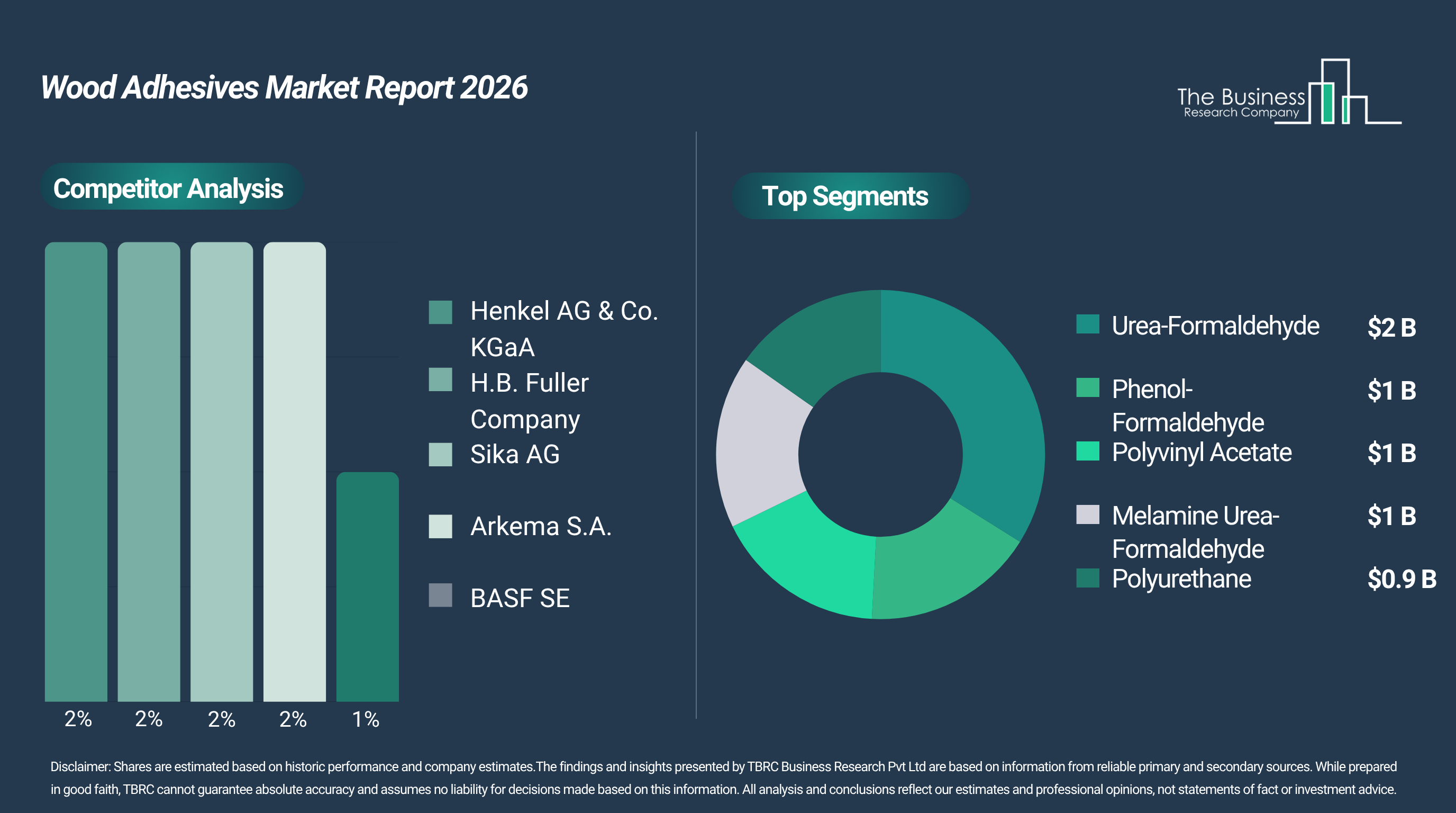
The wood adhesives market is segmented into various product types such as urea-formaldehyde, melamine urea-formaldehyde, phenol-formaldehyde, isocyanates, polyurethane, polyvinyl acetate, soy-based, and others. Among these, urea-formaldehyde is poised to remain the largest segment by 2030, representing 28% of the market or approximately $2 billion in value. This segment benefits from broad applications in particleboard and medium-density fiberboard production, affordability for panel manufacturing, predominant use in interior wood projects, and ongoing improvements in bonding efficiency.
Further segmentation includes technology types like solvent-based, water-based, and other technologies; resin types categorized as natural or synthetic; and applications covering flooring and decks, plywood, furniture, cabinets, windows and doors, among others.
Regional Outlook Highlights Asia-Pacific’s Market Leadership
Asia-Pacific is set to command the largest share of the wood adhesives market by 2030, valued at $4 billion, up from $3 billion in 2025. This growth, at a CAGR of 6%, reflects booming furniture manufacturing, increased engineered wood production, and rising construction activities utilizing wood materials. Investment in advanced woodworking and panel processing techniques within emerging economies also bolsters regional expansion.
Country-Level Analysis Reveals China as the Market Leader
China will dominate the wood adhesives market in 2030 with an estimated value of $2 billion, doubling from $1 billion in 2025 at a robust 9% CAGR. This growth is driven by heightened domestic demand for ready-to-assemble furniture, expanding wood product exports, investments in automated wood processing lines, and capacity growth for advanced adhesive formulations tailored to large-scale production.
Competitive Landscape in the Wood Adhesives Industry
The wood adhesives market is shaped by a mix of global chemical giants and specialized adhesive manufacturers. These players are investing heavily in innovations such as bio-based technologies, enhanced moisture resistance, improved curing processes, and tailored bonding systems for woodworking and construction. Their competition focuses on aspects like bond strength, durability under varied conditions, emission reductions, and adherence to sustainability and safety standards. Recognizing this landscape is critical for stakeholders aiming to capitalize on product innovation, strategic partnerships, and growth opportunities within the evolving wood processing ecosystem.
Market Leadership and Share Distribution Among Top Companies
Henkel AG & Co. KGaA ranked as the top-selling company in 2025 with a 2% share, particularly through its adhesive technologies unit offering reactive adhesives, hot melts, and water-based systems for wood product manufacturing and engineered wood assembly. The wood adhesives market is moderately fragmented, with the top ten players holding 14% of total revenue in 2025. This moderate concentration reflects diverse formulation demands, raw material sourcing, sustainability compliance, and regional production dynamics. Leading companies maintain their edge through wide product portfolios, solid distribution networks, strong industry ties, and ongoing advancements in eco-friendly and high-performance adhesives.
Notable companies and their 2025 market shares include:
• Henkel AG & Co. KGaA (2%)
• H.B. Fuller Company (2%)
• Sika AG (2%)
• Arkema S.A. (2%)
• BASF SE (1%)
• Pidilite Industries Ltd. (1%)
• Dow Inc. (1%)
• Jowat SE (1%)
• Franklin International Inc. (1%)
• Aica Kogyo Company Limited (1%)
Innovations Transforming the Wood Adhesives Market
Fire-resistant adhesive technology is revolutionizing timber construction by enhancing safety, bonding quality, and enabling sustainable use of engineered wood. For example, in February 2025, Henkel AG & Co. KGaA introduced the Loctite HB XE Line — a high-performance polyurethane adhesive designed for cross-laminated timber (CLT) and glued laminated timber (GLT) with advanced fire protection features. This innovation supports stronger fire resistance, streamlines manufacturing, and incorporates sustainable formulation, thereby broadening the possibilities for timber construction and boosting adoption of next-generation wood bonding solutions.
Opportunities for Growth Across Various Wood Adhesive Types
Multiple product categories, including urea-formaldehyde, melamine urea-formaldehyde, phenol-formaldehyde, polyurethane, polyvinyl acetate, isocyanates, soy-based, and others, are expected to collectively add over $2.6 billion in value by 2030. Between 2025 and 2030, significant growth is anticipated with urea-formaldehyde increasing by $1 billion, melamine urea-formaldehyde and phenol-formaldehyde each growing by $0.3 billion, polyurethane and polyvinyl acetate by $0.3 billion apiece, isocyanates by $0.2 billion, and soy-based plus other adhesives contributing $0.1 billion each. These expansions are underpinned by advancements in high-performance, bio-based, formaldehyde-free, moisture- and heat-resistant bonding technologies tailored for engineered wood and sustainable furniture and construction practices.
Effective Strategies to Enhance Market Position
Key approaches for success include innovating with sustainable bio-based adhesive formulations, leveraging advanced resin technologies to improve bond strength and moisture resistance, integrating low-emission adhesives into eco-conscious wood applications, forging strategic partnerships to broaden solution offerings in construction and furniture sectors, and investing in formaldehyde-free and environmentally friendly adhesive technologies.
Major Market Players and the Supply Chain Ecosystem
The wood adhesives market features prominent companies such as Henkel AG & Co. KGaA, H.B. Fuller Company, Sika AG, Arkema S.A., BASF SE, Pidilite Industries Ltd., Dow Inc., Jowat SE, Franklin International Inc., Aica Kogyo Company Limited, AkzoNobel N.V., Huntsman Corporation, Eastman Chemical Company, RPM International Inc., Illinois Tool Works Inc., 3M Company, Jubilant Agri & Consumer Products Ltd, Collano Adhesives AG, Master Bond Inc., Chemence Inc., Permabond LLC, Chemique Adhesives Inc., W.F. Taylor, Surebonder, AJ Adhesives Inc., L.D. Davis Industries Inc., and Cattie Adhesives.
On the supply side, key raw material suppliers include BASF SE, Dow Inc., Huntsman Corporation, Evonik Industries AG, Arkema, Covestro AG, Wanhua Chemical Group, SABIC, INEOS, Eastman Chemical Company, Mitsubishi Chemical Group, LG Chem, Momentive Performance Materials, Borouge, Celanese Corporation, LyondellBasell Industries, Nouryon, Clariant AG, Solvay, and Ashland Global Holdings. Wholesalers and distributors such as Brenntag SE, Univar Solutions, IMCD Group, Azelis, Caldic B.V., Barentz International, Ravago, DKSH Holding, Biesterfeld AG, Safic-Alcan, Connell Brothers Company, Redox Limited, Stockmeier Group, Nordmann, Grolman Group, Helm AG, Omya AG, Barentz, Jebsen & Jessen Group, and ICC Industries support the supply chain.
End users encompass major brands and manufacturers like IKEA, Ashley Furniture Industries, Steelcase, Herman Miller, Mohawk Industries, Shaw Industries Group, Masco Corporation, Armstrong World Industries, Louisiana-Pacific Corporation, West Fraser Timber, Weyerhaeuser Company, Kronospan, Egger Group, Swiss Krono Group, Pfleiderer Group, Boise Cascade Company, Sonae Arauco, UFP Industries, Stora Enso, and Metsä Wood.
What’s included in our 2026 market reports:
• Market attractiveness scoring and analysis
• Total addressable market (TAM) analysis
• Company scoring matrix graphics and tables
• Excel-based forecasting dashboards
• Market hotspots infographics
• Key technologies and future trend analysis
• Updated graphics and tables
Learn More About The Business Research Company
The Business Research Company (www.thebusinessresearchcompany.com) is a leading market intelligence firm renowned for its expertise in company, market, and consumer research. We have published over 30,000+ reports across 27 industries and 60+ geographies. Our research is powered by 1,500,000 datasets, extensive secondary research, and exclusive insights from interviews with industry leaders.
We provide continuous and custom research services, offering a range of specialized packages tailored to your needs, including Market Entry Research Package, Competitor Tracking Package, Supplier & Distributor Package and much more.
Disclaimer: Please note that the findings, conclusions and recommendations that TBRC Business Research Pvt Ltd delivers are based on information gathered in good faith from both primary and secondary sources, whose accuracy we are not always in a position to guarantee. As such TBRC Business Research Pvt Ltd can accept no liability whatever for actions taken based on any information that may subsequently prove to be incorrect. Analysis and findings included in TBRC reports and presentations are our estimates, opinions and are not intended as statements of fact or investment guidance.
Contact Us:
The Business Research Company
Americas +1 310-496-7795
Europe +44 7882 955267
Asia & Others +44 7882 955267 & +91 8897263534
Email: marketing@tbrc.info
Follow Us On:
LinkedIn: https://in.linkedin.com/company/the-business-research-company
Oliver Guirdham
The Business Research Company
+44 7882 955267
info@tbrc.info
Visit us on social media:
LinkedIn
Facebook
X
Legal Disclaimer:
EIN Presswire provides this news content “as is” without warranty of any kind. We do not accept any responsibility or liability
for the accuracy, content, images, videos, licenses, completeness, legality, or reliability of the information contained in this
article. If you have any complaints or copyright issues related to this article, kindly contact the author above.

Media gallery