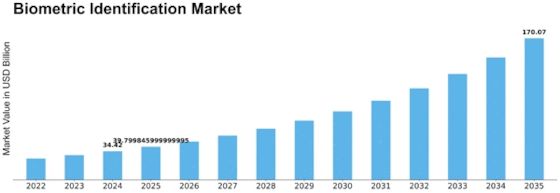
Biometric Identification Market Grows to $170.07 Bn at 15.63% CAGR
Biometric Identification Market is projected to reach USD 170.07 Billion at a 15.63% CAGR, driven by security needs and tech advancements. North America leads, Asia-Pacific fastest growing.

Press Release Disclaimer: This is a press release distributed through the XPR Media network. It has not been independently verified by our newsroom.

North America remains the largest market, while Asia-Pacific is emerging as the fastest-growing region in biometric identification.
NEW YORK, NY, UNITED STATES, September 8, 2026 /EINPresswire.com/ — According to Market Research Future, the Biometric Identification Market is projected to reach USD 170.07 Billion, at a 15.63% CAGR by driving industry size, share, top company analysis, segments research, trends and forecast report 2025 to 2035. This exceptional growth trajectory reflects the escalating global demand for robust security solutions, where biometric identification technologies have become indispensable across government, financial services, healthcare, retail, and transportation sectors. The market’s rapid expansion is underpinned by increasing security concerns, technological advancements in artificial intelligence and sensor technologies, the rising adoption of multimodal biometric systems, and evolving regulatory frameworks addressing data privacy and identity verification standards.
Market Overview
Biometric identification encompasses a diverse range of technologies designed to verify and authenticate individual identity based on unique biological and behavioral characteristics. These systems include fingerprint recognition, facial recognition, iris recognition, voice recognition, and behavioral biometrics that analyze patterns in human activity. The market serves critical applications across law enforcement, border control, access control, financial transactions, and healthcare, providing organizations with reliable, secure, and efficient identity verification solutions that significantly outperform traditional password-based and token-based authentication methods.
The growth drivers for the biometric identification market are diverse and mutually reinforcing. Rapid advancements in biometric technology, including fingerprint, facial, and iris recognition, are fundamentally driving market expansion. Innovations in sensor technology and artificial intelligence are significantly enhancing the accuracy and efficiency of biometric systems. The adoption of deep learning algorithms has notably improved the performance of facial recognition systems, making them more reliable and faster. As manufacturers strive to differentiate their products, the incorporation of cutting-edge biometric sensors is becoming increasingly common, enhancing both user experience and overall vehicle security.
Escalating security concerns serve as another primary catalyst for market growth. The increasing frequency of security breaches and identity theft has heightened the demand for robust security solutions. Organizations across various sectors are increasingly adopting biometric identification technologies to enhance security measures and protect sensitive data. Market forecasts project growth exceeding 20% CAGR in the coming years, driven by the need for advanced security systems that effectively mitigate risks associated with unauthorized access and fraud. Consequently, the integration of biometric solutions is becoming standard practice in sectors such as finance, healthcare, and government, where security is paramount. The Automotive Biometric Market is benefiting from these security trends, as automakers incorporate biometric authentication for vehicle access, driver identification, and personalized vehicle settings, with fingerprint recognition currently holding the largest share in automotive applications due to its established reliability.
The increasing convergence of biometrics with smart technologies and artificial intelligence is transforming the market landscape. AI algorithms are enhancing the speed and reliability of biometric recognition, enabling real-time processing and decision-making across various industries. This integration is particularly evident in the Driver Monitoring System Market, where the incorporation of AI, computer vision, and biometric sensors has expanded system capabilities, making DMS a key component of advanced driver-assistance systems (ADAS) and autonomous vehicle development.
📍 Get Free Sample Report for Detailed Market Insights:
https://www.marketresearchfuture.com/sample_request/29843
Market Segmentation
The biometric identification market is segmented based on technology, application, device type, end-user industry, modality, and regional analysis to provide a comprehensive understanding of the industry landscape.
By Technology: The market is categorized into Facial Recognition, Fingerprint Recognition, Iris Recognition, Voice Recognition, and Behavioral Biometrics. Fingerprint recognition currently holds the largest market share due to its long-standing presence and reliability in identity verification processes, widely adopted across various sectors for its cost-effectiveness and accuracy. Facial recognition follows as the second-highest performing sub-segment, benefiting from advancements in AI and machine learning, with deep learning algorithms improving system performance significantly. Iris recognition is gaining momentum due to its high accuracy and security features, particularly in government and border control applications. The integration of AI and machine learning into biometric systems is enhancing accuracy and reducing false positives across all technology types.
By Application: The market is segmented into Law Enforcement, Border Control, Access Control, Financial Transactions, and Healthcare. Access Control remains the dominant application, driven by the imperative need for enhanced security and the ongoing digital transformation of security protocols across sectors, with technologies such as fingerprint and facial recognition becoming essential in corporate facilities and financial institutions. Healthcare is emerging as the fastest-growing application, leveraging biometric identification for patient authentication and secure access to medical records, driven by stricter regulatory requirements and emphasis on patient privacy. Law Enforcement is experiencing significant growth as agencies worldwide increasingly adopt biometric technologies for crime prevention and investigation. Border Control and Financial Transactions maintain substantial relevance as governments and financial institutions prioritize secure identity verification.
By Device Type: The market is segmented into Contact-based, Contactless, and Mobile devices. Contact-based solutions maintain the largest segment due to their long-standing presence in identity verification processes, particularly in sectors requiring high accuracy and security, such as banking and government. Contactless solutions are quickly gaining traction due to their convenience and efficiency, catering to environments such as airports and retail checkout points. This shift is driven by rising hygiene awareness, demand for faster processing times, and emerging applications in mobile technology and cloud solutions. The trend toward contactless biometrics is expected to accelerate as organizations seek to improve user experiences while maintaining security standards.
By End-User Industry: The market is segmented into Government, Financial Services, Healthcare, Retail, and Transportation. The Government sector holds the largest share due to extensive utilization of biometric technologies for national security, identity verification, and border control. Healthcare is emerging as the fastest-growing segment, driven by increasing adoption of biometrics for patient identification and data security. Financial services and retail represent significant market portions, driven by the need for enhanced security and customer verification processes. The shift toward cashless transactions and rising security concerns are propelling growth across these sectors.
By Modality: The market is categorized into Single-modal and Multi-modal systems. Single-modal systems hold a significant portion of market share, largely due to their simplicity, effectiveness, and reliable performance in specific use cases, making them prevalent in day-to-day operations. Multi-modal systems are experiencing rapid growth as organizations seek comprehensive solutions to enhance security and reduce the probability of false alarms by combining multiple identification methods. The growing preference for multimodal biometric systems reflects the increasing demand for more robust and reliable authentication solutions.
By Region: The market analysis covers North America, Europe, South America, Asia Pacific, and Middle East and Africa, with North America currently holding the largest market share and Asia Pacific expected to witness the highest growth.
🛒 You can buy this market report at:
https://www.marketresearchfuture.com/checkout?currency=one_user-USD&report_id=29843
Regional Analysis
North America remains the largest market for biometric identification, propelled by its strong technological infrastructure and high adoption rates in government and corporate sectors. The region’s leadership is driven by increasing security concerns, technological innovation, and the presence of major market players including IDEMIA and HID Global. Regulatory frameworks such as the Biometric Information Privacy Act are shaping market strategies, particularly concerning data protection and user consent. The integration of biometrics with advanced technologies is fostering innovation and adoption across the region. The Driver Monitoring System Market is particularly strong in North America, reflecting a strong emphasis on safety and regulatory compliance, with regulatory bodies mandating the use of DMS in new vehicles.
Europe ranks as the second-largest market, with significant growth in the financial and healthcare industries driven by stringent regulatory requirements and data protection laws. The European Union’s commitment to data privacy, exemplified by GDPR, is influencing biometric deployment strategies, with organizations navigating compliance requirements while leveraging biometric technologies. Germany leads the region in automotive biometric applications, with premium brands integrating sophisticated driver monitoring and authentication systems. The region’s strong focus on vehicle safety regulations is driving DMS adoption, with Euro NCAP requirements compelling automakers to equip vehicles with comprehensive safety systems.
Asia Pacific represents the fastest-growing regional market, driven by rapid urbanization, increasing vehicle production, and growing awareness of advanced safety features among consumers. China leads the region with the world’s largest automotive manufacturing base and aggressive government initiatives promoting intelligent transportation and security systems. The country’s rapid EV penetration and weekly release cadences at domestic manufacturers including NIO, XPeng, and BYD are creating substantial demand for advanced biometric identification systems. India is emerging as a significant market, supported by rapid urbanization, traffic congestion, and continued investments in public infrastructure. Japan and South Korea continue to demonstrate strong demand for advanced biometric technologies, with leading OEMs investing heavily in driver monitoring and vehicle authentication systems. The region’s growth is further fueled by government subsidies, robust economic growth, and increased automotive and construction activities.
Rest of the World, encompassing South America, the Middle East, and Africa, represents diverse markets with varying growth trajectories. Latin American markets show steady growth supported by recovering vehicle production and increasing consumer demand for modern safety features. The Middle East demonstrates strong demand for premium vehicles equipped with advanced security and identification systems. African markets remain at nascent stages but hold potential as automotive infrastructure develops and vehicle ownership rates increase.
Competitive Landscape and Key Players
The biometric identification market is highly competitive, featuring a mix of established global technology providers, specialized biometric solution developers, and emerging innovators. Leading companies are focusing on strategic partnerships, technological innovation, capacity expansion, and portfolio diversification to strengthen their market positions.
Key players operating in this space include Thales Group (France), NEC Corporation (Japan), IDEMIA (France), HID Global (USA), ASSA ABLOY (Sweden), Fujitsu Limited (Japan), Hitachi, Ltd. (Japan), Safran (France), Bosch (Germany), Continental AG (Germany), Denso Corporation (Japan), Valeo (France), Aptiv PLC (Ireland), NXP Semiconductors (Netherlands), Harman International (United States), Synaptics Incorporated (United States), and Infineon Technologies AG (Germany). These industry leaders leverage extensive technological expertise, global distribution networks, and strong relationships with government and commercial clients to maintain dominant market positions.
IDEMIA stands out in the biometric market due to its extensive experience in identity and security solutions, delivering advanced biometric authentication technologies that ensure user safety while enhancing user experience. The company’s robust product portfolio includes state-of-the-art fingerprint scanners, facial recognition systems, and iris scanning solutions. IDEMIA’s strong partnerships with automotive manufacturers and its commitment to integrating biometric sensors into various vehicle platforms further solidify its presence in the market. Safran plays a pivotal role with its focus on high-performance biometric solutions that are both secure and user-friendly, leveraging strategic collaborations with automotive manufacturers to integrate biometric systems into vehicle platforms.
Latest Industry News and Developments
Recent industry developments reflect the dynamic nature of the biometric identification market. NXP Semiconductors has made headlines with strategic partnerships aimed at bolstering its biometric capabilities in automotive applications. Ams AG and Gentex Corporation are collaborating on innovations to improve driver monitoring systems, reflecting the growing integration of biometric sensing technologies in vehicles. These developments are driven by increased consumer demand for advanced safety features and personalized vehicle experiences.
The market continues to witness significant investment in R&D, with companies focusing on developing solutions that not only detect drowsiness and distraction but also offer real-time feedback to drivers. The rising incidence of cyberattacks has prompted companies like Harman International and Argus Cyber Security to collaborate on new cybersecurity solutions for connected vehicles. The growth of electric and autonomous vehicles is propelling the need for sophisticated monitoring systems to ensure driver attention and engagement, particularly as these vehicles take on more complex driving tasks.
In the broader biometric identification market, the integration of artificial intelligence and machine learning continues to enhance system accuracy and reduce false positives. The adoption of multimodal biometric systems is growing as organizations seek comprehensive solutions to enhance security and reduce the probability of false alarms. Regulatory influences, such as GDPR and the Biometric Information Privacy Act, remain pivotal in shaping market strategies, particularly concerning data protection and user consent.
Market Challenges and Opportunities
The biometric identification market faces several challenges that could impact growth trajectories. Data privacy concerns and stringent regulatory requirements present significant challenges, as organizations must navigate complex compliance landscapes while leveraging biometric technologies. High implementation costs remain a barrier for smaller organizations, limiting adoption in certain sectors. Integration complexities with legacy systems and uneven adoption across developing economies due to limited regulatory enforcement and infrastructure constraints pose additional challenges. The under-supply of semiconductors has created operational challenges, with controller lead times extending as OEMs compete for identical chips.
Emerging opportunities are abundant in the evolving market landscape. The integration of biometric authentication systems for enhanced security presents substantial growth potential, particularly in the automotive sector where fingerprint and facial recognition are enabling secure vehicle access and personalized driver experiences. The development of AI-driven predictive analytics for driver behavior is creating new possibilities for proactive safety systems. Partnerships with automotive manufacturers for OEM solutions are expanding market reach and driving innovation.
The rising demand for connected vehicles, increasing focus on cybersecurity measures, and growth of electric and autonomous vehicles are creating substantial opportunities for biometric identification solutions. The expansion of IoT technologies in automotive applications and government regulations on vehicle security are further driving market growth. The increasing prevalence of mobile biometrics and cloud-based authentication solutions is democratizing access to biometric technologies and expanding the addressable market.
To explore more market insights, visit us at:
https://www.marketresearchfuture.com/reports/biometric-identification-market-29843
Final Market Summary
Key factors expected to influence future development include the pace of AI adoption, advancements in sensor technologies, and the evolution of regulatory frameworks regarding data privacy and security. Consumer preferences for convenient, secure, and seamless authentication experiences will continue to drive innovation across all biometric segments. Government initiatives promoting digital identity and secure access systems will play a crucial role in shaping market trajectories.
The transition toward digital and connected ecosystems represents a fundamental shift in security paradigms, positioning biometric identification as a critical enabler of secure, convenient, and trustworthy interactions across public and private sectors. As organizations and governments continue to prioritize security and user experience, the importance of sophisticated biometric solutions will only continue to grow, ensuring robust demand and market expansion throughout the forecast period and beyond.
More Related Reports from MRFR Library:
Autonomous Emergency Braking System Market : https://www.marketresearchfuture.com/reports/autonomous-emergency-braking-system-market-4665
Automotive Lane Warning System Market : https://www.marketresearchfuture.com/reports/automotive-lane-warning-system-market-4667
Automotive Air Flow Meter Market : https://www.marketresearchfuture.com/reports/automotive-air-flow-meter-market-4712
Vehicle Pillar Market : https://www.marketresearchfuture.com/reports/vehicle-pillar-market-5030
Variable Valve Timing Market : https://www.marketresearchfuture.com/reports/variable-valve-timing-market-5054
Smart E Drive Market : https://www.marketresearchfuture.com/reports/smart-e-drive-market-5189
Automotive Structural Sheet Metal Market : https://www.marketresearchfuture.com/reports/automotive-structural-sheet-metal-market-5300
Automotive Relay Market : https://www.marketresearchfuture.com/reports/automotive-relay-market-5336
Multi Camera System Market : https://www.marketresearchfuture.com/reports/multi-camera-system-market-5357
Automotive Propeller Shaft Market : https://www.marketresearchfuture.com/reports/automotive-propeller-shaft-market-5370
Market Research Future
Market Research Future
+1 855-661-4441
email us here
Legal Disclaimer:
EIN Presswire provides this news content “as is” without warranty of any kind. We do not accept any responsibility or liability
for the accuracy, content, images, videos, licenses, completeness, legality, or reliability of the information contained in this
article. If you have any complaints or copyright issues related to this article, kindly contact the author above.

Media gallery